Ansökan
2001 till FORMAS Forskningsrådet för Miljö,
areella näringar och samhällsbyggnad
Erik Levlin, Mark och Vattenteknik,
Kgl. Tekniska Högskolan
CORROSION OF WATER AND SEWAGE PIPE NETWORKS AND
OTHER URBAN INFRASTRUCTURE BELOW GROUND.
RESEARCH PROGRAMME
INTRODUCTION
The aim of the project is to study the
interaction between soil and groundwater chemistry and corrosion and
degradation of materials, especially iron and concrete that are used in urban
infrastructures below ground such as water and sewage networks. Corrosion
causes shorter life time with renovation need but also environmental problem
through leakage from pipes and tanks. There are a large value invested
especially in water and sewage pipe network during construcion of large
residential areas in the “million programme” during the 60’ies. Other urban
infrastuctures in the ground are cables for telephone and electricity, pipes
for gas and vacuum waste transport and piles for house foundations. Water and
sewage network has been chosen because it is a large part of the urban
infrastructure, but the achieved knowledge is relevant for all infrastructure
made of the same material.
PREVIOUS WORK
Previous work on corrosion in soil
is a base for the project. Aeration cell corrosion in soil has been
studied in laboratory experiments as well as in situ in the soil, corrosion
problems to metallic constructions buried in the soil. An aeration cell is
created when one part of a construction lies in a soil with good permeability
for oxygen, for instance sand, and one part in a soil with poor permeability,
for instance water saturated clay. The part in the soil with good permeability
has a high concentration of oxygen and becomes cathode and the part in the soil
with poor permeability, has a low oxygen concentration and becomes anode.
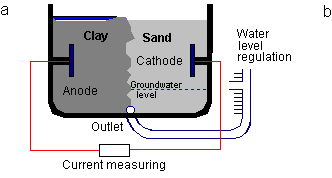
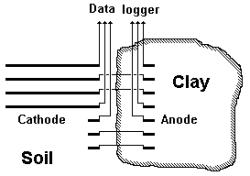
Figure 1. Sketch of
a, laboratory experiments and b, experiments in situ in the soil.
The laboratory experiments (see figure 1a) performed at the laboratory of Water Resources Engineering started year 1986 with finansiation from BFR, the Swedish Council for Building Research and SNV, the Swedish National Board for Environmental Protection (Levlin, 1991). The work was completed in a doctor thesis 1993 (Levlin, 1992). The object was to study the influence of soil acidification on corrosion in soil. To simulate the influence of acidification, two cells were used there one was sprayed with water acidified with sulphuric acid and the other with water without acid. However, the effect of acidification on the corrosion rate was small. Other effects such as the position of the groundwater level had a larger influence on the cell current. The maximum current was achieved then the groundwater level was regulated to just below the aeration cell. This was a result of good oxygen supply through the sand combined with high conductivity of the soil.
The
study on corrosion in situ in the soil (see figure 1b) at a test site in
Göteborg, Sweden was a part of a larger project together with Geology at
Chalmers University of Technology, Göteborg, and the Swedish Corrosion Institute,
Stockholm, financed by BFR. As a reference to the laboratory study the aeration
cells in this project were created and monitored in situ in the soil (Levlin,
1996, Levlin
and Vinka, 2000).
Since it is difficult to find two similar test places, with different degree of
acidification, the influence of acidification could not be studied in the
project. An aeration cell consisted of two carbon steel sheets was buried at a
depth of 1 meter. The anodic sheet was buried in a lump of clay, and the cathodic
was buried in the surrounding filling material. Two aeration cells were used,
one with a cathodic sheet of the same size as the anodic sheets, and another
with a cathodic sheet being 10 times larger. The anode-cathode area ratio of
the cells were 1:1 and 1:10. Both corrosion current and potential were measured
during the 2.67 year test period. As a reference the corrosion potential of
sheets with no connection to any aeration cells were measured. The corrosion of
the anodic sheets in clay can be calculated from the cell current to 31.7 m/year
(2.59 A/cm2) for the cell with area ratio 10 and 5.0 m/year
(0.47 A/cm2) with area ratio 1. The difference in cell current between the cells
increased with time; from about three times larger in the beginning to about
eight. This can be explained by deposition of corrosion products on the
cathodic sheet, causing a larger part of the anodic dissolution to be
transferred to the anodic sheet. The difference in cell current will be 10 with
no corrosion of the cathodic sheets and 1.82 with the same corrosion rates on
both anodic and cathodic sheets.
Also corrosion of concrete pipes in soil have
been studied (Levlin and
Kapilashrami, 1991).
Concrete corrode by chemical dissolution in acid where the rate of corrosion is
proportional to the amount of acid. At the same pH-level a weak acid as
carbonic acid gives a higher corrosion rate than a strong acid. Sulphuric acid
gives rapid attack through formation of a voluminous product, ettringite.
However, sulphuric attacks on concrete sewage pipes is a problem that mainly
originates from hydrogen sulphide produced inside the pipes in the sewage
water. Thus, soil pollution due to leakage from sewage pipes is
both an environmental and a health problem.
RESEARCH TASKS
During
the first year of the project there will be a pre-study identifying different
task for further research. A comparative study including copper and
stainless steel material will be performed in laboratory in the same way as
cast iron has been studied in the earlier investigations. The focus will be on soil and
groundwater chemistry and how it is related to corrosion. Corrosion in soil is
strongly dependent on the type of soil. The competence in soil and ground water
chemistry of the department of Civil and Environmental Engineering, combined
with knowledge in material corrosion gives better possibilities to protect and
estimate life length and renovation need.
The relation between groundwater ion content,
electric conductivity of the soil and pitting corrosion. Corrosion rate is
mainly controlled by oxygen transport through the soil. However, pitting
corrosion resulting in pit holes is by experience preferently occurring in
water saturated soil there oxygen transport is limited. Ions in the groundwater
originating from the soil controlls the electrical conductivity of the soil,
which is an important parameter for pitting corrosion. Increased ion content in
the groundwater caused by salt used for deiceing the streets during wintertimes
may be a risk for getting increased pitting corrosion on pipelines in the
ground.
Pit holes caused by pitting corrosion cause
leakages on water pipelines. For
pitting corrosion to occurre the metal surface must be covered with a layer of
corrosion products so that anodic dissolution preferently takes place at
defects in the protective layer. Formation of corrosion products are
preferentially occurring in well aerated soils, but pitting corrosion
resulting in pit holes is by experience preferentially
occurring in poor aerated water saturated clay soil where oxygen
transport is limited. Water saturated soils have a good electric conductivity
and the corrosion current can be transported long distances which makes it
possible for the cathodic reaction on a large surface to supply one growing
hole. The penetration rate will be proportional to the amount of corrosion
current supplied to the hole. One possibility is precipitation of metal
sulphide on the surface in poor aerated soils concentrates the anodic
dissolution to defects in the sulphide layer, causing formation of pit holes.
Another possibility is that protective coating of for instance plastic
concentrates the corrosion to defects in coating thus increasing the risk of
getting pit holes. Without the coating there will be a even distributed
corrosion on the surface limited by the rate of oxygen diffusion through the
water saturated soil to the pipeline. In that case an unprotected pipeline may
have a longer life than one with a protective cover.
Another possibility to protect underground pipe
network is to use cathodic protection. The effectiveness of cathodic
protection of pipelines in the soil. The effect of cathodic protection is best in corrosive soils with good
electric conductivity. However, the risk of getting corrosion is
not eliminated, only less probable and other problems such as induced corrosion
on other structures in the ground may occur. Figure 2 shows examples of successful and a
non-successful cathodic protection of a defect in the protective layer. If the
defect is created due to losening of the protective layer the protective
current may have a long way to reach the bottom of the crevice. The large
potential drop to the bottom of the crevice may cause that the bottom is not
enough polarized to get protected against corrosion. Other effects that may
cause corrosion are that the soil gets dry and the electric conductivity
becomes too low to transport the protective current (Jack and Wilmott, 1995).
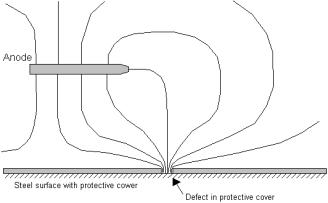
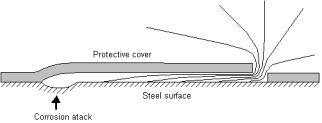
Figure 2. Examples of successful and a
non-successful cathodic protection of a defect in the protective layer. If the
defect is created due to loosening of the protective layer the protective
current may not reach the bottom of the crevice created between the layer and
the steel surface.
RELEVANCE FOR SOCIETY
About 60 % of the cost for municipal
water and sewage system is the cost for the pipe network. The cost of
maintainance of urban pipe network in the ground is high due to the cost for
excavation and rebuilding the street after maintainance, which can be up to 80
– 85 % of the cost of repairing a pipeline. Even if an alternative material choice
is more expensive, the municipalities can save money if the life length of the
pipes can be prolonged. If the cost for using cast iron is 15 % for the pipes
and 85 % for excavation and the cost of an alternative pipe material is twice
the cost for cast iron pipe, the maintainance cost can be reduced if the
expected life length will be more than 15% longer (figure 3).
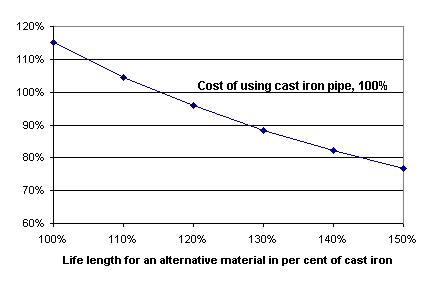
Figure 3. An comparision of costs if the cost for using cast iron is 15 % for the pipes and 85 % for excavation and the cost of an alternative pipe material is twice the cost for cast iron pipe.
Alternative
materials can be stainless steel or copper. However, it is not obvious that
stainless steel or copper in the soil environment is a better material than
cast iron. Stainless steel is sensitive to localised corrosion such as crevice
and aeration cell corrosion. On stainless steel crevices can create corrosion
attack due to limited supply of oxygen to the crevice causing a poor surface
oxide without protective properties. On copper the corrosion is less in
crevices due to decreased diffusion of copper from the surface inside the
crevice increasing the copper concentration in the crevice and thus reducing
the corrosion. In sulphide rich anaerobic soil a layer of copper sulphide will
protect a copper surface (Levlin, 1995). Critical evaluation of results made by
material manufacturers is an important part of the work. An important requirement for the project is that
cooperation is initiated between expertise in soil chemistry and material
corrosion.
REFERENCES
Levlin, E. (1991) Corrosion of
underground structures due to acidification: laboratory investigation. British
Corrosion Journal, Vol. 26, No. 1, pp. 36 - 66
Levlin, E. (1992) Corrosion of water pipe systems due to acidification of
soil and groundwater. Doctors theesis
in Applied Electrochemistry and Corrosion Science, TRITA-TEK 1992:01,
ISBN 91-7170-094-3, KTH 1992
Levlin, E. (1995) Corrosion of copper in anaerobic
clay. Prerequisites for pitting and whiskers formation.SKB Projekt Inkapsling,
Projekt PM PPM 95-3420-09, Stockholm.
Levlin, E.
(1996) Aeration cell
corrosion of carbon steel in soil: In
situ monitoring cell current and potential. Corrosion Science Vol. 38, No.
12, pp. 2083-2090,
Levlin, E. and Kapilashrami, S. (1991) External corrosion of
concrete pipes in soil water environment. Influence of acidification caused by
air pollution. TRITA-VAT-1901, 51 pages, KTH 1991
Levlin, E. and Vinka, T.-G. (2000) Corrosion in an urban soil profile - Aeration cell
experiment In situ in the soil. Eurocorr 2000, London,
UK, 2000.09.10–09.14, CD-ROM.
Jack, T. R. and Wilmott, M. J. (1995) Indicator
minerals formed during external corrosion of line pipe, Materials Performance,
November, pp. 19-22