Forskningsprojektbeskrivning
FORMAS-ansökan 6 maj 2003
Erik Levlin, Mark och Vattenteknik,
Kgl. Tekniska Högskolan
RESEARCH PROGRAMME
Method development for sustainable and integrated
sewage and organic waste handling - Phosphorus recovery by ion exchange from
incineration ash and Supercritical Water Oxidation residues.
Background
Organic waste exist both as sewage sludge from
wastewater treatment and as municipal organic waste from for instance
households. Sustainable handling
of municipal organic waste and sewage sludge has as an important goal to
recycle resources without supply of harmful substances to humans or the
environment (Levlin 1999, Hultman and Levlin, 1997). Another important goal is
to avoid to deposit waste and sludge on landfill. In Sweden a tax of 250
SEK/ton on all deposited solid waste was introduced year 2000 (SFS 1999:673). Deposition of incinerable waste has been prohibited and in year 2005 there will be a ban on deposition
of all organic material on landfill (SFS 2001:512). Incineration (ATV, 1997) and SCWO, Super Critical Water Oxidation
(Gidner et al., 2000), are methods that eliminates all organic content and the
potential energy of the organic material can be utilised. SCWO occurs in water
of a supercritical phase at a temperature above 374 °C and a pressure higher
than 22 Mpa. Sludge incineration requires that the sludge has to be dried to 40
% dry substance. The energy produced from the incineration is consumed by the
drying and there is therefore no net energy recovery from sludge incineration.
With use of SCWO, energy can be recovered also from sewage sludge and organic
waste with too low dry substance for incineration. Anaerobic digestion eliminates
half of the organic content and half of the energy can be utilised as methane
gas. Increasing the energy recovery from sewage sludge and organic waste
decreases the need of fossil fuel and makes the society more sustainable.
Handling of sludge and organic waste can be integrated by use of food waste
disposers and transporting the organic waste to the wastewater treatment plant
with the sewer net (Karlberg and Norin, 1999). The resources in sludge and
solid organic waste remaining after SCWO or incineration are nutrients such as
phosphorus. Development of method to recover these resources from incineration
ashes will make handling of municipal organic waste and sewage sludge more
sustainable.
Since phosphorus is needed as a
fertilizer in the agriculture, a requirement for getting sustainable wastewater
treatment is to create method to recover the phosphorus from the wastewater.
Most of the phosphorus used in the agriculture originates from mining of
phosphate ores which thus is a limited resource. The global deposits of
economically mineable phosphate are estimated to be 109 ton
phosphorus and the total amount phosphorus in the sediments is estimated to be
1015 ton (Butcher et al., 1994). Many different phosphate minerals
are available, but only apatite (calcium phosphate, Ca3(PO4)2) is used
for phosphate production (Corbridge, 1995). Phosphate can be economically
produced by leaching apatite mineral with sulphuric acid (McKetta and Cunningham
1990):
Ca3(PO4)2
(s) + 3 H2SO4 + 3x H2O ¾® 2 H3PO4 + 3 CaSO4·xH2O
(s)
In 1995 the world phosphate rock production was 160 000 ton per year (as
P2O5), having tripled over the last 40 years. About
90% of this amount is used as fertiliser. At this rate of consumption the known
apatite reserves have been estimated to last for a period up to 1000 years.
However, if the present increase in world population and the increasing need
for fertiliser for food production is taken into account, the supply of
phosphate may well be crucial within a century. Apatite ore is thereby the
limited resource that must be preserved by phosphate recovery.
Phosphorus recovery through leaching with acids and bases
Phosphorus recovery from ash and SCWO-residues
by leaching with acids and bases in order to recover phosphorus from sludge or ash has been studied in previous
projects (Hultman et al,. 2002,
Levlin et al., 2002, Stark 2002). Use of acid leaching dissolves phosphorus but
also metal ions thus creating a mixture phosphoric acid, metal ions and anions
from the acid. If hydrogen chloride is used to dissolve ferric phosphate the
solution will contain zero-valent phosphate together with ferric and chloride
ions.
FePO4 (s) + 3 H+ + 3 Cl- ¾® H3PO4o + Fe3+ + 3 Cl-
The chemical consumption for recovery through leaching with acid was found
to be a function of the molar ratio of iron and phosphorus in the sludge
(Hultman et al,. 2002, Levlin et al., 2002):
|
Chemical consumption in equivalents |
= 5000 + 6000 * |
mole Fe in the
sludge/tonne DS |
|
tonne DS (dry
solids) |
mole P in the
sludge/tonne DS |
Half of the amount of chemical is needed for
leaching and half of the amount is needed for separating phosphorus from the
leachate. In Sweden, chemical precipitation by use of iron salts is due to stringent
restriction on phosphorus content in effluent the most used method for
phosphorus removal.
To produce phosphoric acid the other ions has
to be separated in a further step. In the BioCon process for phosphorus
recovery from incineration ash, an ion exchange process has been proposed
(Svensson, 2000). In the KREPRO process proposed for Malmö, phosphorus is after
leaching with sulphuric acid recovered by precipitation as ferrous phosphate.
In the BioCon process intended for Falun, the ion exchange process has been
abounded and phosphorus is intended to be recovered as in the KREPRO process as
iron phosphate. Without removing the iron, phosphate will preferentially be
precipitated as iron phosphate, which has a lower solubility than for instance
calcium phosphate. However, iron phosphate has no commercial value as raw
material for the phosphate industry, and the low solubility makes it less
favourable to use as fertilizer. Since the phosphate in the sludge originate
from phosphorus products produced from apatite ore, recovering the phosphate as
iron phosphate will not preserve the limited apatite resources. Iron phosphate
is a much more common mineral in the ground than apatite.
Leaching with bases to recover phosphorus has
the advantage that a phosphorus product without metal contamination is
obtained. In the AquaReci process
is SCWO-reside leached with base and recovered as calcium phosphate through
precipitation with lime.
However, many phosphate compounds are insoluble in base, which reduces the degree
of recovery then leacing with base.
Phosphorus recovery with ion exchange material
In this project use of ion exchange material for recovery of phosphorus and
separation of metals from ash and SCWO-residues will be studied. Phosphorus
recovery with ion exchange material produces a phosphoric acid free from metal
ions. In mixing ash or SCWO-residues with a cation exchange material, hydrogen
ions from the cation exchange material will dissolve the metal phosphate. The
ion exchange material will take up the dissolved metal ions and a metal ion
free phosphoric acid will remain in the solution.
CEX=H3 + FePO4 (s) ¾® CEX=Fe
+ H3PO4o
After mixing the ion exchanger with ash or
SCWO-residues, metal ions will be transferred to the ion exchanger and a phosphoric
acid containing leachate will be obtained. Since dissolution of phosphate and
separation of metals is made in the same process step the needed amount of
chemical will be half of the amount needed for acid leaching followed by
separation of metals in a following step. The next step in the process (see
figure 1) is to separate the ion exchange material. By using balls covered with
ion exchange material, the ion exchanger can be separated by a sieve which let
the fine grinded ash or SCWO-residues to pass through. An other alternative is
to use magnetic ion exchange material which can be separated magnetically. A
process there magnetic ion exchange resin is mixed with sludge and separated
with a magnetic drum has been studied by Swinton et al. (1989). In an acid bath
the ion exchange material is recharged with acid and the metal ions are
released. By centrifuge the phosphoric acid containing leachate is then
separated from ash or SCWO-residues and the phosphoric acid can be concentrated
by evaporation. Use of ion exchange processes, make it possible to recover the
phosphate as phosphoric acid, which is produced from apatite ore, thus
preserving the limited apatite ore resources and also other resources, mainly
sulphur, needed for producing phosphoric acid from apatite.
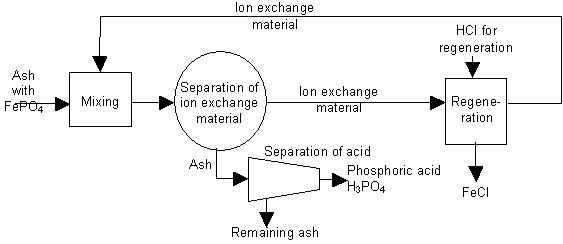
Figure 1. Process scheme for leaching of ash or SCWO-residues and
separation of phosphoric acid from metals.
PROJECT METHODOLOGY
Literature studies on phosphorus recovery with ion exchange (see
enclosed paper: Ionexchn.pdf) have been made in
previous work about sustainable sludge handling and presented at seminars
(Levlin, 2001). The ion exchange process has also been presented as parts of
other reports (Balmér et al., 2002 and Hultman et al., 2002). The work in this
project is mainly laboratory experiments based on the literature study.
In the first phase the project be performed
through experimental work in the Water laboratory at the Department of Land and
Water Resources Engineering, KTH, there phosphorus recovery with use of
different cation exchange materials shall be studied. Different methods for
mixing and separation of ion exchange material with ash and SCWO-residues will
be tested. The achieved degree of phosphorus recovery will be measured as well
as the metal content of produced phosphoric acid and remaining ash and
SCWO-residue. Some of the analysis can be made at the Water laboratory at KTH,
and other has to be done on external analyse laboratories. In this project phase
is salary for laboratory personal, analysis, ion exchange material and other
commodities needed for the experimental work included in the budget.
During the last phase of the work the results
will be evaluated and presented in reports, conference presentations and
articles in international scientific papers. The potential of the process for
recovery of phosphorus from sewage and organic waste will thereby be evaluated.
REFERENCES
ATV (1997). Klärschlammverbrennung Beseitigung oder Verwertung. Korrespondenz Abwasser, Vol. 44, No. 10, pp. 1880-1884.
Balmér P., Book K.,
Hultman B., Jönsson H., Kärrman E., Levlin, E., Palm O., Schönning C., Seger
A., Stark K., Söderberg H., Tiderström H. and Åberg H. (2002) System för
återanvändning av fosfor ur avlopp. Naturvårdsverket
Rapport 5221.
Butcher
S.S., Charlson R.J., Orians G.H. and Wolfe G.V. (1994). Global
Biogeochemical cycles, 2nd ed., Academic Press Ltd, ISBN
0-12-147685-5.
Corbridge
D.E.C. (1995). Studies in Inorganic Chemistry 20, Phosphorus. An Outline of
its Chemistry, Biochemistry and Uses, 5th ed., Elsevier Science,
ISBN 0-444-89307-5.
Gidner, A., Almemark, M., Stenmark, L. and Östengren, Ö. (2000). Treatment of sewage sludge by supercritical
water oxidation. IBC´s 6th Annual Conference on Sludge. Feb. 16th-17th
2000, London, England.
Hultman, B. and Levlin, E. (1997). Sustainable
sludge handling, Advanced Wastewater
Treatment Report No. 2, Proceedings of a Polish-Swedish seminar, KTH,
Stockholm, May 30, 1997, Joint Polish - Swedish Reports, Div. of Water
Resources Engineering, KTH, TRITA-AMI REPORT 3044, ISBN 91-7170-283-0, KTH
1997, Paper
5.
Hultman, B., Levlin, E., Löwén, M., Mossakowska, A. and Stark, K.
(2002). Utvinning av fosfor och andra produkter ur slam och aska, Slutrapport. (Extraction of phosphorus and other products
from sludge and ashes, Final report) Stockholm Vatten AB, R nr 02,
feb 2002.
Karlberg T., and Norin E. (1999). Köksavfallskvarnar – effekter på
avloppsreningsverk. (Food
waste disposers – effects on wastewater treatment plants) VA-Forsk Rapport
1999-9.
Levlin
E. (1999). Resources recovery from incineration ashes, Proceedings of a
Polish-Swedish seminar, Join Polish Swedish Reports Report No. 5, Div. of
Water Resources Engineering, KTH, TRITA-AMI REPORT 3063, ISBN: 91-7170-439-6. pp.
43-53.
Levlin, E. (2001). Recovery of phosphate and
separation of metals by ion exchange. Proceedings of a Polish-Swedish
seminar Nowy Targ Poland, 2001.10.24-10.26, Report No 9. Joint Polish -
Swedish Reports, Div. of Water Resources Engineering, KTH, TRITA-AMI REPORT
3088, ISBN: 91-7283-190-1, pp. 81-90.
Levlin E., Löwén M., Stark K. and Hultman B. (2002). Effects of phosphorus recovery requirements on
Swedish sludge management. Wat. Sci. Tech. Vol. 46, No. 4-5, pp.
435–440,
McKetta J.J. and Cunningham W.A. (1990). Alloy
selection, Phosphates, Encyclopedia of
chemical processing and design, 35 Petroleum fractions properties to phosphoric
acid plants, Marcel Dekker Inc., ISBN 0-8247-2485-2, 429-495.
Stark K. (2002). Phosphorus release from
sewage sludge by use of acids and bases. Dep. Land and Water Resources
Engineering, KTH, licentiate thesis, ISBN 91-7283-307-6.
Svensson A. (2000). Fosfor ur avloppsslam – en studie av KREPRO-processen och BioCons process ur ett livscykelperspektiv, Master Thesis Kemisk miljövetenskap, Chalmers University of Technology, Gothenburg Sweden.
Swinton E.A., Eldridge R.J. and Becker N.S.C. (1989). Extraction of heavy metals from sludges and muds by magnetic ion-exchange. Sewage sludge treatment and use: new developments, technological aspects and environmental effects. Elsevier science publ. ISBN 1-85166-418-1, pp. 394-404.